Welcome to the gateway of our Dental Licensure Series, a series built for one purpose: to help internationally trained dentists understand exactly what it takes to practice in the United States, state by state, without guesswork.
Here’s the distinction worth understanding before anything else. A dental degree tells the world you are trained. A dental licensure is what a specific U.S. state grants you, permitting you to practice legally within its borders, and that permission is never awarded nationally. It’s decided fifty different times, by fifty separate dental boards, each with its own requirements for what counts as qualified. Two dentists with identical training can face two entirely different paths simply because of the state they choose. That single fact is why dental licensure deserves serious consideration well before you commit to school, a residency, or a move.
This introductory blog about dental licensure lays that groundwork. It explains what dental licensure is, why requirements vary so significantly from state to state, and what variation means for how you plan your next steps. It also introduces the three primary pathways into U.S. dental practice, which are CAAPD, PASS, and Dental Assisting, and walks through the dental licensing requirements that tend to recur across states, so you know what to expect before you dive into the specifics.
Consider this your orientation. The state-specific guides that follow will take you the rest of the way, covering the exact requirements, programs, and timelines for wherever you’re headed.
Table of Contents
ToggleWhat is Dental Licensure?
A dental degree tells the world you’re qualified to practice dentistry. A dental license tells a specific U.S. state that you’re legally permitted to do so within its borders. The degree is academic; the license is regulatory; and only one of them lets you see patients.
This is worth sitting with, because the confusion between the two is genuinely common, and understandably so. In many countries, graduating from a dental school and registering to practice are close to the same event, sometimes even handled by the same body in short order. In the U.S., they are deliberately separated. Every dentist, whether American-trained or internationally trained, must be licensed by the dental board of the state where they intend to practice, regardless of where or how impressively they trained. A Harvard DMD and a degree earned abroad both stop at the same door, The State Board.
That door doesn’t open automatically, unfortunately. It opens through a specific, often multi-year process including steps like the right education, the right examinations, the right paperwork, filled in the right order. Skip a step, or misunderstand what a program actually qualifies you for, and you can find yourself fully trained and still unable to practice. That’s the gap this series exists to close.
Why Does Dental Licensure Vary by State?
If you take one idea away from this entire series, let it be this: there is no such thing as a single national dental license in the United States. There are fifty-plus versions of it, one per state board.
Each state (and the District of Columbia) has its own state board. A body of practicing dentists, hygienists, and public members appointed ot set and enforce the standards for who gets to practice within the state. These boards were established independently, over different decades, in response to different local pressures, and they have never been consolidated into one federal standard. The result is a patchwork. California’s requirements aren’t Florida’s, and Florida’s aren’t New York’s, even though all three are, in the end, asking the same underlying question, is this person safe and qualified to treat patients?
In practice, that paperwork shows up in a very few recurring ways. States differ on which clinical examinations they’ll accept, some rely on ADEX, some still reference WREB-era pathways, and a few are beginning to weigh newer formats like DLOSCE. They differ on whether a residency (an AEGD or GPR) can substitute for a clinical exam, and if so, how long the residency needs to be. They differ on how they treat degrees earned through advanced standing or supplemental programs for internationally trained dentists, some recognize a wide slate of these programs, others recognize very few. And they differ in the smaller but no less consequential details like fees, fingerprinting rules, how long a passing exam score stays valid, and whether a state grants anything resembling reciprocity to dentists already licensed elsewhere.
None of this is arbitrary bureaucracy for its own sake. It reflects fifty different boards, each independently deciding what “qualified” looks like. But for an applicant, it means the same underlying question, How do I get licensed?, can have a genuinely different answer depending on where you’re standing. That’s precisely why this series is organized state by state, and why the guide for your target state deserves a careful read before you commit to any pathways.
Pathways to Dental Licensure
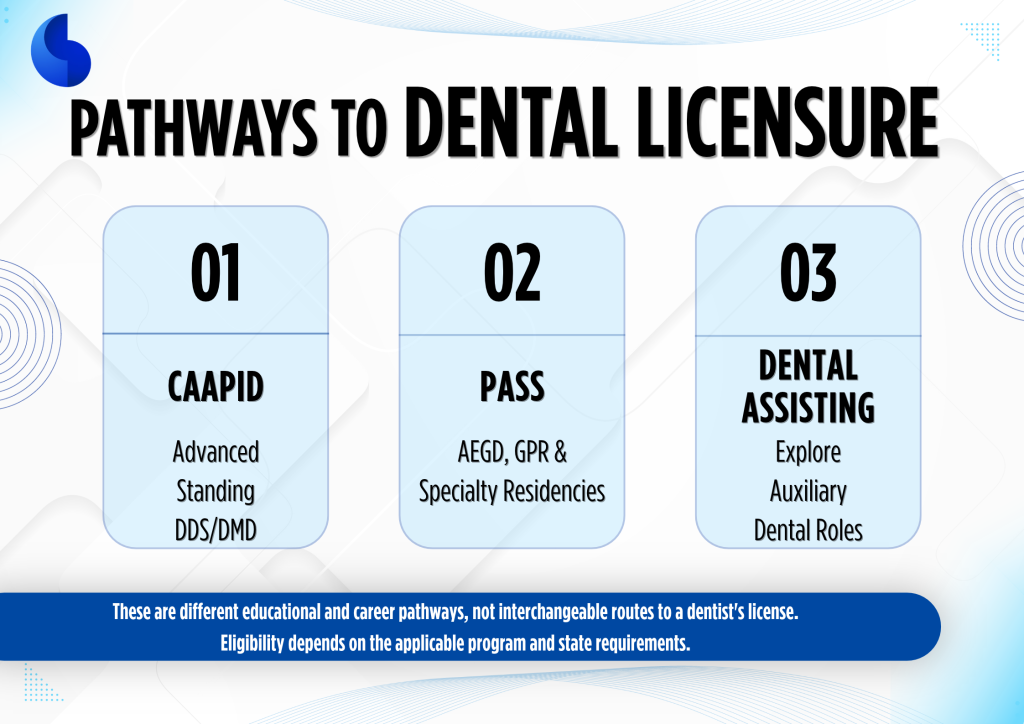
Internationally trained dentists generally arrive at U.S. licensure through one of the three broad routes. None is inherently “better” than the others, each suits a different starting point, timeline, and goal.
4.1 CAAPID (Advanced Standing DDS/DMD)
The Centralized Application for Advanced Placement for International Dentists (CAAPID) is the pathway most people picture when they think about becoming a dentist in the U.S. after training abroad. It’s a single, centralized application, run through ADEA, that lets you apply to multiple advanced standing programs at once. These programs are typically two to three years long, and they culminate in a full, CODA-accredited U.S. dental degree, a DDS or DMD earned on American soil, under American faculty, and alongside American students.
CAAPID is generally the right fit for dentists who want the credential itself, a U.S. degree that opens the widest possible range of doors, including in states that are otherwise selective about which foreign qualifications they’ll recognize. It’s also, correspondingly, the most competitive and most expensive route, where seats are limited, admissions are selective, and the time and financial commitment are real. It’s a serious undertaking, and it should be chosen deliberately, not by default.
4.2 PASS (AEGD, GPR & Specialty Residencies)
ADEA PASS is the application system for postdoctoral residencies like Advanced Education in General Dentistry (AEGD), General Practice Residency (GPR), and various specialty programs. These are typically one to two years, considerably shorter and less expensive than an advanced standing degree program, and they sit on their own separate calendar from CAAPID.
Here’s the nuance worth holding onto, a residency is not automatically a licensure pathway. In some states, completing a qualifying AEGD or GPR is explicitly recognized as one route to a dental license. In others, it isn’t recognized that way at all, or it’s recognized only under narrower conditions than people assume. The residency itself is genuine, valuable clinical training either way, but whether it moves you toward a license depends entirely on the state you’re aiming for, which is exactly the kind of detail our state-specific guides spell out.
4.3 Dental Assisting
Less commonly discussed, but genuinely relevant for some applicants, is dental assisting, which is working as a Registered Dental Assistant, or in a similarly licensed auxiliary role, while pursuing a longer-term path toward practicing as a dentist. It isn’t a shortcut to a dentist’s license, and it isn’t the right fit for everyone. But for some internationally trained dentists, particularly those still weighing their options or building U.S. clinical experience and income while other applications are pending. It can be a meaningful and legitimate part of the picture.
Requirements here vary just as much by state as anything else in this series, like what counts as qualifying education, what exams are required, and what duties an assistant is permitted to perform, all shift from one dental board to the next. We’ll cover this in detail in every state guide.
Common Licensure Requirements Across States
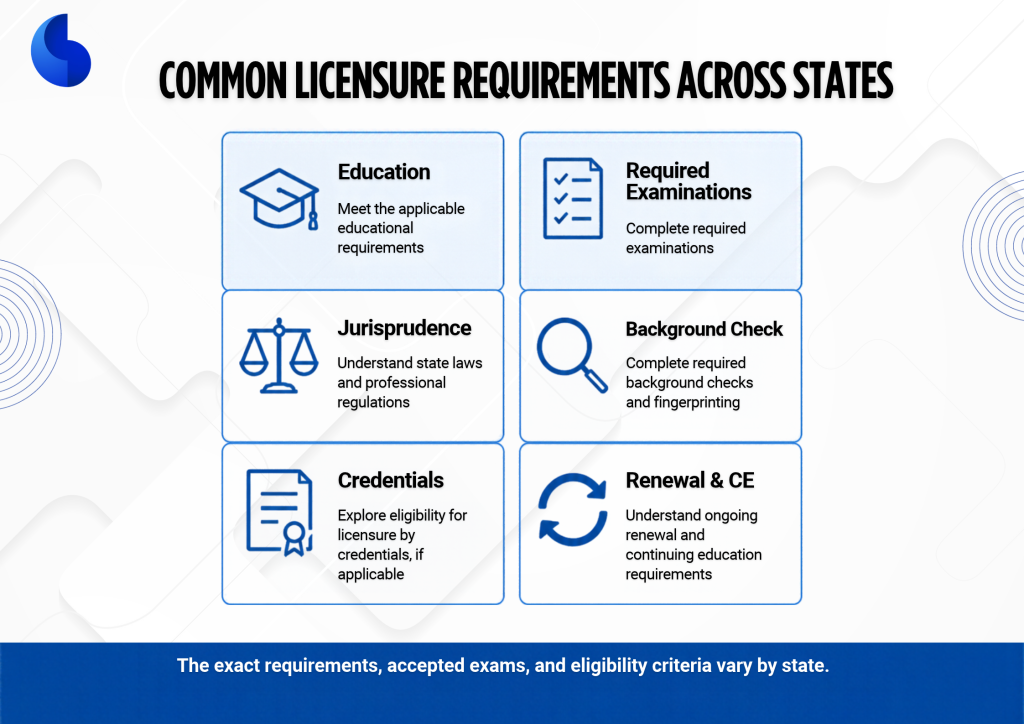
Underneath all that state-by-state variation, though, most licensure pathways ask for a similar handful of things. Knowing the list in advance means you’ll recognize each requirement when you meet it in a specific state’s guide, rather than encountering it cold.
5.1 Educational requirements
Nearly every pathway requires graduation from a dental program that’s either CODA-accredited or specifically approved by the state board in question. For internationally trained dentists, this is usually where an advanced-standing DDS/DMD program or a state-recognized supplemental program comes in.
5.2 Clinical Examination Requirements
Most states require passing a recognized clinical examination, most commonly ADEX today, though some states still reference older regional exams, and a few are beginning to incorporate newer formats. Alongside this sits the INBDE (Integrated National Board Dental Examination), the written exam nearly every pathway requires, regardless of which clinical exam a state accepts.
5.3 Jurisprudence (Law & Ethics) Examinations
Separate from clinical competency, states want to confirm you understand their specific laws, ethics rules, and scope-of-practice regulations. Nearly every state has its own version of the exam, and its required no matter how you arrived at licensure otherwise.
5.4 Background Checks & Fingerprinting
A near-universal requirement, usually run through state and federal (DOJ/FBI) channels, confirming there’s nothing in an applicant’s history that would disqualify them from practicing.
5.5 Licensure by Credentials
For dentists who are already licensed and practicing in one U.S. state and want to move to another, some states offer a “by credential” pathway, like recognizing existing licensure and verified practice history in place of re-sitting a full clinical exam. This is universal, and where it exists, it usually comes with its own specific conditions.
5.6 License Renewal & Continuing Education
Getting licensed isn’t the end of the story. Every state requires periodic renewal, almost always tied to continuing education (CE) hours, to keep licensure active.
Each of these categories will reappear, filled in with real specifics, in every state guide that follows, think of this list as the checklist you’ll be running down state by state.
Common Misconceptions About Dental Licensure
A few myths circulate consistently enough that they are worth addressing directly, up front.
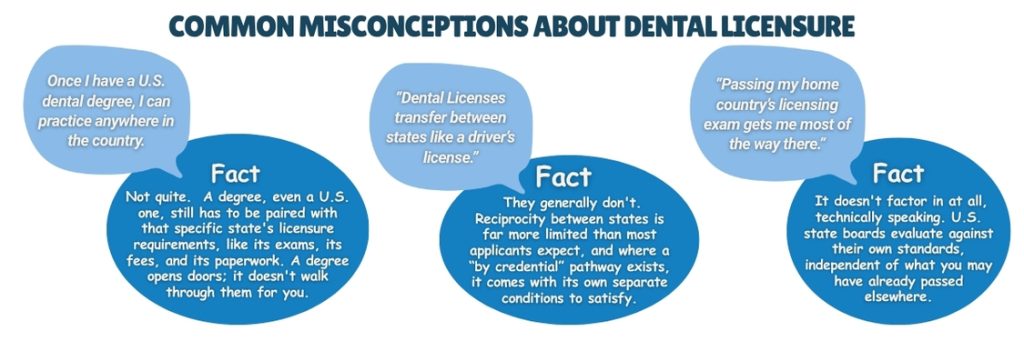
Getting clear on these early saves a great deal of wasted time, money, and disappointment later.
Choosing the Right State
Given everything above, the state you choose to pursue isn’t a minor detail, its arguably the single most consequential decision in this entire process, and it deserves to be made deliberately rather than by geography or gut feeling.
A few things worth weighing, where do you actually want to live and build a career, long term? Which advanced standing or residency programs are realistically within reach for your background, and which states do those specific programs feed into? How competitive is the pathway you’re considering in that state, and how does its cost compare to your other options? And practically, does the state’s board recognize the credential you’re planning to earn, and does it offer a reasonably efficient path to licensure once you have it?
There’s no universally “best” state. There’s a best state for you, given your training, your resources, your timeline, and where you ultimately want to practice. The guides are built to help you answer that question with real information, not guesswork.
Our State-by-State Dental Licensure Series
From here, this series moves into individual state guides, each one built to the same standard and covering the same ground, so you can compare states directly against one another.
Every state guide in this series covers the state dental board and its role, an overview of that state’s licensure pathways, advanced standing DDS?DMD programs available in-state (where relevant), PASS residency opportunities and whether they contribute to licensure there, the CAAPID route as it applies in that state, the full run of educational, examination, and background-check requirements,
The complete licensure process after graduation, state-specific considerations, including recent policy changes, the dental assisting pathway in that state, and, finally, an honest read on whether that state is a strong option for internationally trained dentists specifically, along with common misconceptions and practical tips.
If you already know you’re pursuing CAAPID, start with the advanced standing programs listed in each state guide and work outward from there. If you’re leaning towards PASS, pay closest attention to each states residency-to-licensure rules, since thats where the real variation lives. And if dental assisting is part of your plan, each guide’s dental assisting section will walk you through what state specifically requires.
Conclusion
A few key takeaways from everything above, a dental degree and a dental license are distinct things, granted by different authorities, and the gap between them is exactly where plans stall for applicants who weren’t told the rules change at the state line. Licensure in the U.S. is decided state by state, not nationally, which makes the state you choose as consequential as the program you choose. And there is more than one legitimate way in CAAPID, PASS, and Dental Assisting each suits a different starting point, with no real shortcuts around understanding what your chosen state requires.
This isn’t meant to be daunting, its meant to be clear. Thousands of internationally trained dentists navigate this system successfully every year, and understanding it well in advance is what makes that possible.
From here, the path forward is simple, find your state/pathway in the series and explore its guide. That’s where the specific requirements, programs, and timelines live, and where your plan starts to take real shape.