Imagine the CAAPID process as a dental appointment that you need to undergo to receive a clean bill of health to proceed. The TOEFL serves as your dental check-up, ensuring your English language skills are “cavity-free” and that you are ready to take on the academic CAAPID adventure that awaits you. Before you can soar, you must navigate the linguistic landscape TOEFL now offers, redesigned with adaptive testing, a new section order, revised tasks, and updated scoring. “What is TOEFL? How do I prepare?” Let us embark and delve deep into this evolving TOEFL odyssey together.
In this blog, we break down the new TOEFL format introduced in 2026, covering its adaptive structure, updated sections, revised tasks, and new scoring system, while clearly explaining what has changed from the older version, what to expect on test day, and how CAAPID applicants can prepare strategically and confidently.
But before we dive deeper into the changes, let’s take a moment to revisit and understand the basics of TOEFL.
a. What is TOEFL?
The Test of English as a Foreign Language, commonly referred to as “TOEFL”, is a standardized English language test designed to measure your proficiency and your ability to incorporate the English language in an academic/professional setting. It is a pertinent and integral aspect of several university applications. It is a widely accepted and recognized measure of English proficiency by several institutions, including CAAPID.
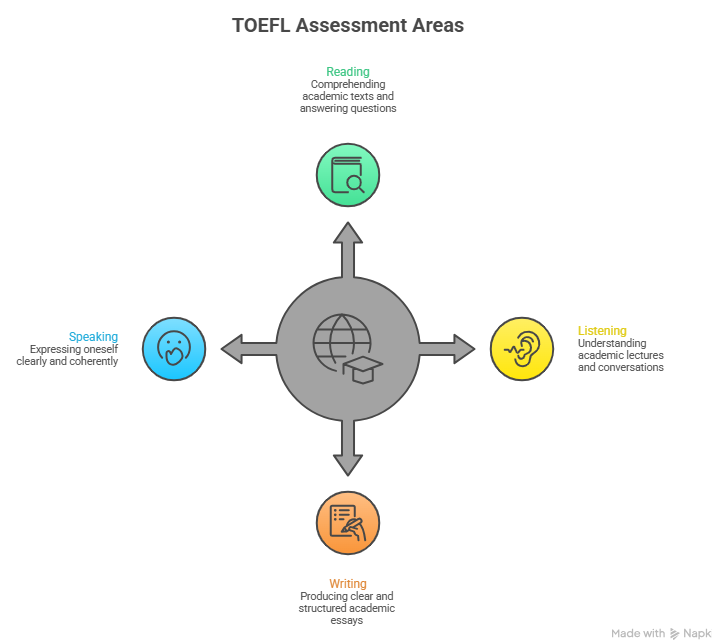
b. A breakdown of what TOEFL assesses:
- Reading: Your ability to comprehend academic texts and provide answers based on the questions the information presents you with.
- Listening: The test also assesses your ability to hear or “listen” to academic lectures, conversations, and regular spoken English conversation materials, and understand them.
- Writing: Your ability to write academic material like essays and respond to given prompts in a clear, structured, and grammatically correct manner.
4. Speaking: Your ability to express yourself clearly and coherently in spoken English.
c. Types of tests available:
- Internet-based Test (iBT)
- Written Test
- At Home (iBT Home Edition)
CAAPID & TOEFL- The unexpected tryst
You might wonder, “Why does a future dentist need proficient English as a requisite aspect to being a dentist?” The answer lies in the intricate dance between CAAPID and TOEFL. Although dentistry might seemingly appear to be a purely scientific and clinical field, effective communication is the foundational cornerstone of dentistry’s edifice. Let us further explain and discover how TOEFL plays a vital role in your CAAPID journey.
a. Importance of TOEFL for CAAPID
Amongst a myriad of reasons, here are a few aspects that the TOEFL helps with in the CAAPID process
- Efficient and Effective Communication with Patients: Dentists require solid English skills to communicate effectively with patients, explain procedures, and address concerns. This becomes even more critical in U.S. clinical settings where informed consent, patient education, and documentation are tightly regulated.
- Collaboration with colleagues/dental teams: TOEFL scores demonstrate your ability to collaborate effectively with dental professionals from diverse backgrounds.
- Access to Research and Continuing Education: Proficiency in English is essential for accessing dental research, attending conferences, and staying updated on the latest advancements in the field. Most dental journals, CE courses, and licensure exams are conducted in English, making language proficiency essential for professional growth.
- Cultural Sensitivity: Understanding English can help you navigate cultural differences and provide culturally sensitive patient care.
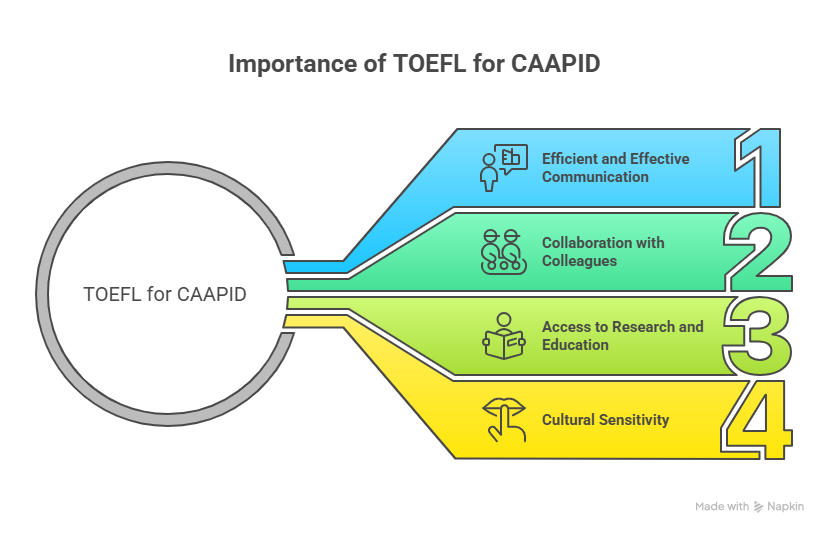
New Addition: In today’s U.S. dental schools, this proficiency is tested not just in classrooms but in live patient interactions, case discussions, and clinical documentation. TOEFL now reflects these real-world communication demands more closely, making it a practical indicator of how well an applicant will function in a fast-paced clinical setting.
TOEFL then and now
Old vs New Toefl Patterns
For most recent applicants, TOEFL meant the shortened July 2023 format that ran through November 2024 and continued to be used right up until January 20, 2026. That version trimmed test length and removed one long essay, but it still followed the classic passage-and-lecture style. From January 2026 onward, ETS rolled out a fully redesigned, adaptive TOEFL that is shorter, more dynamic, and far more focused on how you actually use English in everyday academic and campus life.
Sl. No. | Section | Old TOEFL Pattern ( 2023 – Jan 2026) | New TOEFL Pattern (From Jan 2026) |
1 | Reading | 2-3 academic passages, 10 questions each | 50 items in 30 min: complete the words, read in daily-life contexts, and read one academic passage |
2 | Listening | 3 lectures (6 Qs each) + 2-3 conversations (5 Qs each) | 47 items in 29 min: listen & choose a response, conversations, announcements, and academic talks |
3 | Writing | 1 integrated writing task + 1 academic discussion | 12 items in 23 min: build a sentence, write an email, and write for an academic discussion |
4 | Speaking | 4 tasks (2 independent + 2 integrated) | 11 items in 8 min: listen and repeat + interview-style speaking |
5 | Test Design | Fixed difficulty and fixed question sets | Adaptive format where Reading and Listening adjust based on your performance |
6 | Time & Flow | 2 hours, with longer blocks per task | 1.5 hours, faster pacing with strict per-question timers |
7 | Real-life Focus | Mostly academic passages and lectures | Mix of real-world daily English (emails, ads, short talks) plus academic content |
Key features of the New TOEFL format (2026)
1. Shorter test duration: The whole exam is now much tighter. The new structure runs in roughly 1.5-2 hours (you should still allow extra time for check-in). It’s designed to reduce fatigue and speed up delivery.
- Fewer long reading passages: Reading now mixes short, daily-life texts, fill-in-the-blank tasks, and a single academic passage (about 50 items/30 minutes), so you’re tested on practical and academic reading.
- New writing tasks: The old long independent essay has been replaced by quicker, task-based items: sentence building, a short email (100 words), and an academic discussion task (12 items/23 minutes).
- Adaptive Reading & Listening: Reading and Listening use a multistage adaptive design: difficulty shifts based on your performance, so the test homes in on your level faster.
- All scored sections contribute: The report now gives section band scores (1-6) that average into an overall band; note that ETS still embeds some unscored tryout items for research within modules.
- Faster score reporting & transitional comparator: Scores use the CEFR-aligned 1-6 band; during the transition, ETS also shows a 0-120 comparator for institutions.
- More real-life focus: Across sections, you’ll see campus and daily-life scenarios (announcements, posters, emails), so the exam mirrors how you actually use English at school.
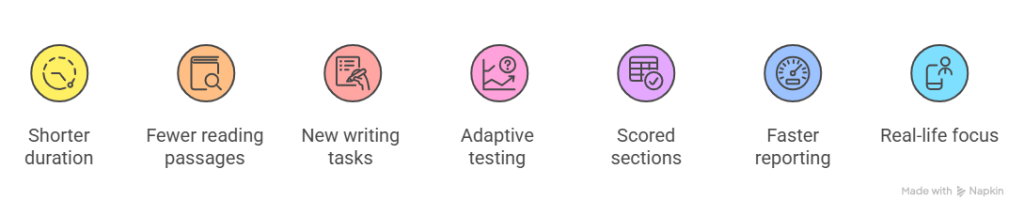
The new TOEFL format (2026)
Sections:
Here’s a complete Breakdown of the New TOEFL Sections:
Section | Number of Items | Time | Question Types / Tasks | Key Notes |
Reading | ~50 items | ~30 minutes | • Complete the words (fill-in-the-blanks) • Read daily-life contexts (ads, posters, notices) • One academic passage | Adaptive across modules; mix of practical + academic reading; shorter passages instead of long dense texts |
Listening | ~47 items | ~29 minutes | • Listen and choose a response • Short conversations • Announcements • Academic talks | Fast-paced; some questions allow only 6-8 seconds to answer |
Speaking | ~11 items | ~8 minutes | • Listen and repeat prompts • Interview-style questions | 7 repeat tasks + 4 interview questions; brief pause before speaking; interviewer may appear on screen |
Writing | ~12 items | ~23 minutes | • Sentence building (drag-and-drop) • Short email (min ~100 words) • Academic discussion response | Task-based and concise; structured prompts; focuses on clarity and practical writing |
Overall test run time is roughly 1.5 to 2 hours, depending on pacing and modules. The Reading and Listening sections adapt to your performance, so module length and difficulty can vary.
New Addition: Quick update: As of January 21, 2026, TOEFL switched to a shorter, adaptive format that tailors Reading and Listening to your performance and swaps in more real-life tasks. Scores now report on a CEFR-aligned 1-6 band (with a transitional 0-120 comparator for institutions during the transition). In short, the new TOEFL focuses on everyday academic and campus communication rather than only dense academic passages. It’s kinder to real exam conditions.
Understanding the New TOEFL score system:
1) CEFR band reporting (1 to 6)
ETS now reports section and overall proficiency using a CEFR-aligned band scale (1 to 6). Each section receives a band, and an overall band is shown on your report. This aligns TOEFL reporting with international proficiency standards.
2) The 0 to 120 comparator during transition
During the transition period, ETS will include a familiar 0 to 120 score on reports alongside the new CEFR bands. That comparator is provided by ETS so institutions can see both formats while they adjust their requirements. ETS supplies these values on the official report, not the other way round.
3) ETS conversion guidance and the official table
ETS has published concordance guidance so institutions can map CEFR bands to the traditional 0 to 120 ranges. Use the ETS table to interpret where a CEFR band sits relative to the older numeric scale. The table is meant for reference during the transition and is standardized by ETS.
4) What schools actually see on your score report
Admissions offices receive:
- Section band scores (1 to 6)
- Overall CEFR band
- A 0 to 120 comparator while the transition is active
5) Old scores remain valid
Scores taken on earlier versions of TOEFL remain valid for two years from the test date. If you took the older test before January 21, 2026, and your score is still within the two-year window, institutions will continue to accept it. ETS explicitly maintains score validity through the normal two-year period.
6) Should you retake the test?
This depends on two practical factors:
- Does your existing, still-valid score meet your target schools’ stated requirement? If yes, no need to retake.
- If you think the new format plays to your strengths (shorter passages, task-based writing, conversational speaking), and your current score is below target, consider retaking. Many candidates appear to do better under the new format. Use the ETS official practice material to simulate the format first.
Understanding the ETS score conversion table (and why you shouldn’t panic)
There has been a lot of confusion around the ETS score conversion table, especially after the introduction of CEFR band scoring. Let’s break it down clearly in five simple points:
- Your Score Is Not Being “Converted” Behind the Scenes: The ETS table that maps CEFR bands to the traditional 0-120 score is meant purely as a reference tool. If you take the new TOEFL, your primary score is your CEFR band. ETS simply provides a comparative 0-120 score alongside it so that schools familiar with the older format can interpret your performance. You do not need to calculate anything yourself.
- Schools Receive Both Scores During the Transition: If you are a new-format test taker, your official score report includes:
- Your CEFR band score
- A comparative 0-120 score
If someone took the older TOEFL before January 21, 2026, their report continues to show only the traditional 0-120 score. During this transition phase, schools may receive applicants with both formats. That is exactly why ETS includes the comparative score.
- Section Scores Are Not Converted: One major point clarified during the live session is that only the overall score receives a comparative 0-120 number. Individual section scores are reported as CEFR bands. They are not individually converted back into the old numerical format.
- Old Scores Are Still Valid: If you took the TOEFL before the format change and your score is still within the two-year validity window, it remains fully valid. Schools will continue accepting those scores until they expire. This comparative reporting will continue during the transition period so that both old and new test takers are evaluated fairly.
- The Table Exists to Help Schools, Not to Confuse Applicants: The ETS concordance table exists to help admissions committees interpret scores across formats. It does not mean your CEFR band will be downgraded, recalculated, or reweighted. Your CEFR band is your primary result. The 0-120 number is simply a comparative anchor while institutions adjust to the new system.
Inside the New TOEFL: Dr. Mihir’s first-hand experience with the 2026 format:
Dr. Mihir, one of our CAAPID applicants, recently took the redesigned TOEFL and shared his experience with us in a live session. Having taken the older TOEFL before, his perspective is especially helpful because he could clearly compare how the new version feels in real test conditions.
The short answer?
According to Dr. Mihir, the new TOEFL has more questions, but it feels much easier, lighter, and far more practical than the old format.
- First Impressions at the Test Center
Mihir took the exam in New York, and from the moment he walked in, he noticed that things felt different. The interface was smoother, the headphones were newer, and the overall setup felt more modern. He mentioned that the upgraded headphones made audio clarity noticeably better, which helped reduce listening fatigue.
One big structural change he immediately noticed was the order of sections.
Instead of Reading → Listening → Speaking → Writing, the new TOEFL now runs as:
Reading → Listening → Writing → Speaking
He said he walked in feeling calm because he had reviewed the section sequence beforehand, but he also knew this was a brand-new test and something unexpected could come up.
- Reading: Easier, Faster, and More Real-Life
Reading was one of Mihir’s strongest sections, and he felt the difference right away. The section was split into two adaptive modules, but the timing surprised him:
- Module 1: about 35 questions in 17-18 minutes
- Module 2: about 15 questions in 10-12 minutes
So instead of two halves, the first module was much heavier.
The types of reading tasks included:
- Fill-in-the-blanks
- Posters and advertisements
- Daily-life passages
- A small academic passage at the end
Mihir said the fill-in-the-blank questions were extremely easy. Many passages were short, around 50-60 words, followed by multiple blanks. If you understood the context, the answers almost came naturally. He could solve some of these in under two minutes.
The academic part was a bit tougher, but it was only a small portion. That made a huge difference for him. In the old TOEFL, he used to score around 17-18 in reading, but in the new format, he scored 24, a big jump. He believes this new reading style benefits anyone who struggled with dense academic passages earlier.
Because the section is adaptive, the difficulty changed based on how fast and accurately he answered. When he solved the easy fill-in-the-blanks quickly, the later ad-based and lecture-style questions became more challenging.
- Listening: Easy Content, But Time Is Everything
Mihir found the listening content to be very natural. The conversations felt like everyday English: people talking, asking simple questions, and responding in a normal way. The section included:
- Listen and choose a response
- Short conversations
- Announcements
- Academic lectures
Each question had only 7-8 seconds to answer.
Once the audio finished, the clock started. If you didn’t click an answer in time, the question disappeared, and you lost the point. Mihir actually lost one question this way, not because he didn’t understand it, but because he took too long.
He described it as the biggest surprise of the exam. The total listening time was around 30 minutes, but individual questions had wildly different timers. Some lecture questions only allowed 30-40 seconds.
Even with that, he still scored well and felt the listening was easier than the old TOEFL because the content itself was simple and familiar.
- Writing: Smooth, Structured, and Stress-Free
Writing used to be Mihir’s weakest area in the old TOEFL, but in the new format, it became one of his strongest.
The writing section now has three parts:
- Sentence building: Ten drag-and-drop questions where you arrange words into correct sentences. Mihir felt all ten were easy and believes he got them all right.
- Email writing: He had 7 minutes to write an email about broken gym equipment. The subject line was already provided, and he just had to write at least 100 words.
- Academic discussion: A professor gives an opinion, and you write your response in about 10 minutes. This felt similar to the old TOEFL.
Mihir liked that writing now comes third instead of first. He felt more warmed up by the time he reached it.
- Speaking: Easy, But Focus Is Everything
The speaking section had 11 questions:
- 7 listen-and-repeat tasks
- 4 interview-style questions
In the listen-and-repeat tasks, he heard a sentence, then there was 3-4 seconds of silence, then a beep, and only then could he speak. That silence confused him.
That brief silence was unexpectedly distracting and caused him to forget parts of sentences.
In the interview section, the screen showed a video of an interviewer who nodded, smiled, and moved their hands. It felt more like a real conversation rather than robotic.
The scenario was about joining a research program as a volunteer, and questions included:
- Have you done research before?
- What are you doing now?
- What are your interests?
Youtube – TOEFL 2026 New Format Explained | Dr. Mihir’s First-Hand Test Experience | Caapid Simplified
TOEFL 2026 FAQs
Q: Does that mean we have to be more attentive during the first couple of questions in Reading?
Ans: Yes. The first few questions matter because Reading is adaptive. If you answer them well, the difficulty increases. If you struggle, it decreases. So you need to be attentive, especially in the first module. Also, the first section often has short passages with multiple blanks, so saving time there helps in the academic passage.
Q: How many questions are there in Reading? Is it fixed?
Ans: ETS does not show an exact number. It gives a range of around 45 to 50 questions. It may vary slightly depending on performance since the section is adaptive.
Q: Can you go back to the first module in Reading after moving to the second?
Ans: No. Once you finish the first module and move to the second, you cannot go back.
Q: Are listening questions visible on screen while the audio plays?
Ans: No. In the new format, when they speak the question, you will not see the question text. You must listen carefully. Once it’s gone, it’s gone.
Q: Is note-taking recommended during Listening?
Ans: It depends on the person. The conversations are short, around four to five sentences. For shorter tasks like announcements and conversations, it may be better to focus fully rather than take notes because time is limited. For academic lectures, you may take brief notes if needed.
Q: How much time do you get per Listening question?
Ans: Around 6 to 8 seconds per question, depending on the length of the question and answers.
Q: Is the Listening section timed as a whole or per question?
Ans: Unlike the old format, where a block of time was given for multiple questions, the new format gives individual time limits per question.
Q: How many tasks are there in Listening?
Ans: Four tasks:
Listen and choose a response
Listen to conversations
Listen to announcements
Listen to an academic lecture
Q: Is the academic lecture in Listening similar to the old TOEFL?
Ans: Yes. The academic lecture portion remains similar to the old format.
Q: How many modules are there in Reading?
Ans: Two modules. The first module may have around 35 questions with about 18-19 minutes. The second may have around 15 questions, with about 8-10 minutes.
Q: Is the time division equal between the Reading modules?
Ans: No. The first module may have more questions and more time than the second.
Q: Is the Writing email format structured? Do they give subject lines?
Ans: Yes. The subject is already written. You just need to write the email body and sign off appropriately.
Q: Is there a minimum word requirement for the email?
Ans: Yes, at least 100 words.
Q: Is the time for writing sufficient?
Ans: Yes. There are 23 minutes total. 7 minutes for email. 10 minutes for academic discussion. Around 6 minutes for 10 sentence-building questions.
Q: For Speaking, do you get preparation time before answering interview questions?
Ans: No. Once you hear the beep, you must start speaking immediately.
Q: How long do you get to answer each interview question in Speaking?
Ans: Around 45 seconds per question.
Q: What is the interview section like in Speaking?
Ans: It simulates a research interview. Questions begin with basic background and move into details about interests and research goals.
Q: Is the interviewer AI or a real person?
Ans: It is a video of a person. It feels conversational because the person nods and reacts, making it more realistic.
Q: Are there visual aids in the Speaking section?
Ans: Yes. In listen-and-repeat tasks, diagrams may appear on screen, and areas are highlighted while the sentence is spoken to help you follow the context.
Q: Is the Speaking section harder than before?
Ans: It moves quickly. The challenge is the short pause before the beep. If you lose focus during that pause, you may forget part of the sentence.
Q: Will new TOEFL scores be converted to 0-120?
Ans: Yes, but only as a comparative value. Your main score is the CEFR band. Schools receive both the band score and a comparative 0-120 score during the transition period.
Q: Will schools consider only the 0-120 score?
Ans: No. Schools receive both scores. The CEFR band is the primary reporting format for new test takers. The 0-120 score is provided for reference.
Q: Do section scores get converted to 0-120?
Ans: No. Individual sections are reported as band scores. Only the overall score is shown with a comparative 0-120 number.
Q: Is the conversion table on the ETS website something applicants need to calculate?
Ans: No. Applicants do not need to convert anything. ETS provides both values on the official report.
Q: How long are scores valid?
Ans: Two years, including old-format scores taken before the change.
Q: When do you receive your scores?
Ans: Reading and Listening band scores appear immediately after finishing the exam. Writing and Speaking scores arrive in about 4 days.
Q: How long did you prepare?
Ans: Around one month, lightly. About three to four hours per week.
Q: What resources did you use?
Ans: ETS free practice tests, YouTube materials for the new format, and ChatGPT for sentence-building and fill-in-the-blank practice.
Putting it all into action
How to register for the TOEFL test:
Registering for the TOEFL test is a straightforward process.
- Create an ETS Account: Visit the official TOEFL website (https://www.ets.org/toefl) and create an account (ETS now lists the new adaptive TOEFL format effective from Jan 21, 2026, so your account will show the updated test options and score-reporting details).
- Choose a Test Date and Location: Select a test date and location that suits your schedule and preferences. Ensure you register well in advance, as test dates can fill up quickly; you can choose an at-center or Home Edition slot, and should check availability for the new, shorter test windows.
- Pay the Test Fee: Pay the required test fee using your preferred payment method. Fees and any local taxes or service charges will be shown during checkout.
- Confirm Your Registration: Review your registration details and confirm your choice. After registration, you’ll receive information about the test format and scoring (reports for tests taken from Jan 21, 2026, onward include CEFR band reporting plus a transitional 0-120 comparator).
How to prepare for TOEFL 2026
- Use ETS official free practice tests first, at least once, to understand the question types, pacing, and on-screen interface before using any third-party resources.
- Practice fill-in-the-blanks and sentence-building tasks regularly, since these appear heavily in both Reading and Writing and are easy scoring opportunities if you’re comfortable with them.
- Focus on speed and instinct, especially for listening, because many questions allow only minimal time to select an answer before they disappear.
- While practicing listening, train yourself to listen attentively without relying on notes, as the conversations are short and note-taking can waste precious seconds.
- Practice listen-and-repeat speaking tasks by playing short audio clips and repeating them aloud after a brief pause, since even a few seconds of silence can affect recall.
- For Speaking, mentally place yourself in a teacher or professor role while responding, as this naturally improves clarity, tone, and structure.
- Use YouTube videos specifically updated for the new TOEFL format to see how real questions look and how quickly transitions happen between tasks.
- Use ChatGPT only for practice, such as generating sentence-building exercises, fill-in-the-blank reading passages, and mock email prompts. Do not use it for memorizing the answers.
Recommended resources
- BestMyTest: A valuable online resource for practice tests and expert feedback.
- Notefull videos
- Magoosh blogs, videos, and a 1-month/ 6-month subscription
- ETS- Website, Quick prep, and official Guide
- Barron’s
- Princeton Review
- Manhattan Prep
(New additions to the list)
- TestGlider TOEFL Mock Tests
- TST Prep
- Mometrix TOEFL Practice Questions & Review
- Examen English Practice Tests & Exercises
Additional resources
- Podcasts
TED talks daily (Every weekday; Pioneers from various industries throw light on the recent advancements in a multitude of fields)
The Economist (Every weekday; Covers current affairs, finance, science, and technology)
BBC Global News Podcast (Twice a day on weekdays, daily on weekends)
BBC World Service- News Review (updated on a weekly basis; explains how to use the language from the latest news in one’s everyday English) - Documentaries
- Rachel’s English (This channel can enable the correct pronunciation of English words)
- Purdue OWL- Can be used for the assessment of the practice essays
- Grammarly- This can be used to weed out errors in grammar and punctuation. In addition, it can be used for the purpose of paraphrasing.
- Magoosh Vocabulary Flashcards application(To learn the meaning and usage of words within a wide range of difficulty levels)
(New additions to the list)
- EdX TOEFL Test Preparation (by ETS)
- TestDEN TOEFL Practice Tests & Simulators
- Notion TOEFL Templates & Flashcards
- Quizlet TOEFL 2026 Flashcard Sets
- Udemy TOEFL Courses
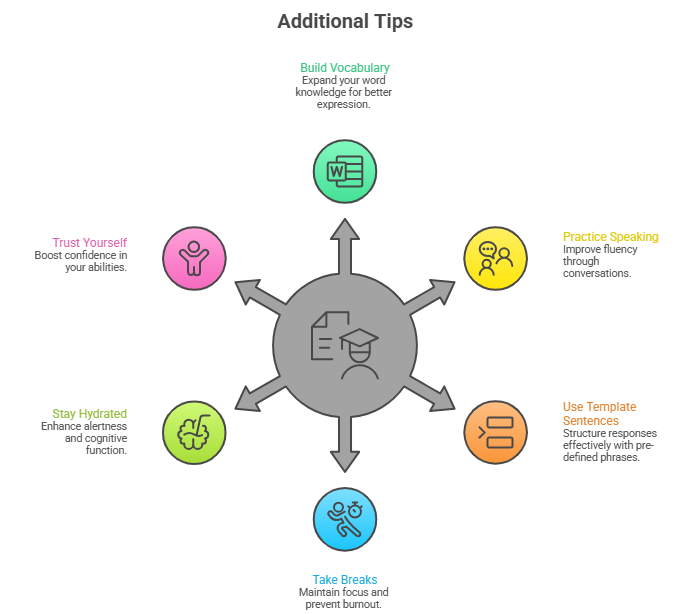
Additional tips
- Build Vocabulary and Grammar: Enhance your language skills.
- Practice Speaking Fluently: Engage in conversations with native speakers or language partners.
- Use Template Sentences: Structure your writing and speaking responses effectively.
- Take Breaks: Short breaks can help you stay focused.
- Stay Hydrated: Drink water to stay alert.
- Trust Yourself: Believe in your preparation and abilities.
TOEFL v. IELTS: What’s the difference?
Both TOEFL and IELTS are widely accepted English language proficiency tests. However, they differ in their format and scoring. TOEFL is primarily computer-based, while IELTS offers both computer-based and paper-based formats. TOEFL uses a point-based scoring system, while IELTS uses a band score system. The speaking section of TOEFL is computer-based, whereas IELTS involves a face-to-face interview with an examiner. In terms of writing, TOEFL includes both integrated and independent writing tasks, while IELTS focuses on academic writing tasks.
Let us compare the two:
Sl.No | Feature | TOEFL | IELTS |
1 | Full form | Test of English as a Foreign Language (TOEFL) | International English Language Testing System (IELTS) |
2 | Format | Computer-based | Computer-based or writing-based |
3 | Scoring | Points (0-120) | Bands (0-9) |
4 | Speaking | Computer-based | Face to face |
5 | Listening | Lectures, conversations, listening comprehension, and multiple-choice questions | Lectures, conversations, multiple-choice questions + sentence completion, and note-taking |
6 | Reading | Academic texts, reading comprehension, multiple-choice questions, and sentence completion, | Academic texts, multiple-choice questions, sentence completion, matching headings, and summary completion |
7 | Writing | Integrated and Independent | Two Academic tasks: Academic Task 1 (report) and Academic Task 2 (essay) |
Important disclaimer about TOEFL
The TOEFL redesign is still in its transition phase. Schools are updating eligibility language and score reporting requirements. Always verify with individual programs regarding:
- CEFR band expectations.
- Section minimums.
- Acceptance of old-format scores.
Institution-specific guidance always overrides general advice.
Conclusion:
You’ve navigated the complexities of the TOEFL, from understanding its structure to mastering effective study techniques and tools, peppered with additional expert tips. With this knowledge, you’re well-prepared to conquer this linguistic hurdle and unlock the doors to a bright future in dentistry. Remember, every journey starts with a single step. So, take that first step, and let’s make your TOEFL journey a success story, and one day soon enough, you can be the TOEFL expert giving other aspirants like yourself tips to ace the test!